 Kayaking- General Information for beginners
Kayaking- General Information for beginners
Kayaking- General Information for beginnersJinaka Canoe Guides offer kayak coaching up to BCU 2
Star, but do not have a large number of kayaks, so for large groups, clients will need to
provide their own kayaks.
What is a Kayak?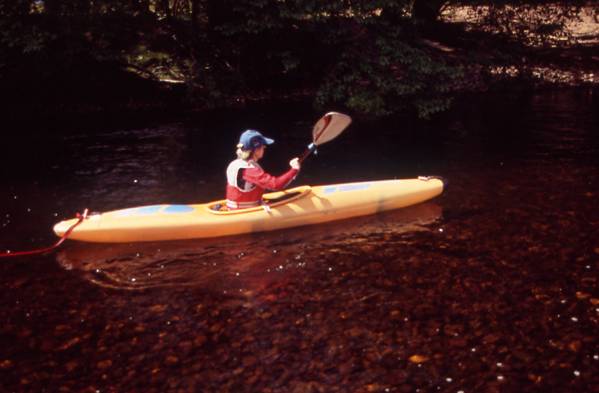
In general, it is boat with an enclosing top which can be paddled by one or more people
using paddles with two blades.
It should not be confused with a canoe.
Shape and length:
Not all kayaks are the same shape. The shape and length affect the stability, turning
ability, speed and acrobatic ability. Beginners will benefit from more stability. Longer
kayaks take more turning and have a higher hull speed than short ones, whereas short
kayaks can be turned easily and used for acrobatics.
Solo and double kayaks:
Most kayaks are solo boats, there being only one seat. There are also doubles kayaks, but
these are not beginner's boats.
Paddle skills:
The paddle skills required depend on the type of paddle used. Broadly speaking, the most
common paddle has two blades at opposite ends of a shaft which enables strokes on both
sides of the kayak to be made one after the other. A single paddle can be used, but this
is not usually the case for beginners.
Comfort:
The general sitting position in a kayak is with outstretched legs. This position takes
getting used to and some people will not find it comfortable. In contrast, in canoeing it
is easy to change position and keep comfortable without having to get out of the canoe. It
is worth taking the time to use the back support and foot brace adjustments to be as
comfortable as you can.
Clothing:
The clothing you choose to wear will depend on the weather and water conditions. Good
quality clothing should keep you warm, retain only a small amount of water when wet, and
dry quickly.
Rolling:
Prospective beginners to kayaking quite often make the comment "Oh, those are the
things you have to roll!", but rolling really does have to be put in context. At a
beginner's level, if you fall in, you can just remove yourself from the kayak, get help,
and get back in when it has been turned the right way up and emptied of water. As you
become more skilled, you will fall in less often. However, with increased skills, there
are other challenges that look enticing, and eventually the skill of rolling will be of
benefit.
Enjoyment:
Keeping dry and warm for as long as possible will increase the likelihood of you enjoying
kayaking. Enjoyment can range from just relaxing, watching wildlife, improving your
balance and paddling skills or becoming part of your environment. The amount of equipment
you can carry in a kayak is limited compared with a canoe.
Safety:
Always wear a correctly sized buoyancy aid. If there is any risk of head injury (e.g.
excited children waving paddles about, knocking one's head on rocks), wear a suitable
helmet.
How to get started:
If you are under 18 years old you should look for a provider certified by AALA (the
Adventure Activities Licensing Authority). Jinaka Canoe Guides has an AALA Licence - details.
If you are over 18 (not covered by AALA), you should look for a provider with British Canoe Union (or equivalent) qualifications
relevant to the type of environment in which you will be kayaking.
To make an enquiry or to book, please send us a message
and we will reply to you.
Home Page