 Canoeing- A General Guide for beginners
Canoeing- A General Guide for beginners
Canoeing- A General Guide for beginnersRead on for general information on canoeing, or see how to book
and prices, or send us a message.
Jinaka Canoe Guides offer a range of canoeing activities for the beginner
as well as canoeists with experience.
We provide a range of good quality canoes which can be paddled solo or double together
with buoyancy aids, helmets, paddles, safety equipment and advice.
We prefer to arrange a day to suit a group rather than have a fixed programme, which is
why we speak to prospective clients.
Prerequisite Skills: It is not necessary for
you to have any water skills prior to canoeing for the first time. However, it is
important that you will be able to be comfortable sitting or kneeling in a canoe (or
whilst watching the TV) for up to a half hour at a time, as well as be calm in the
event of an involuntary swim. You will be able to have breaks and to stretch your legs
'ashore'. If you have any doubts about this, you should reconsider the appropriateness of
canoeing. Canoeing uses more coordination than strength so there will be no need for you
to have anything other than a reasonable level of fitness. There are many skills that will
be demonstrated and used, some of which are canoeing skills while others are related to
living with nature. A key objective is to see how comfortable we can be and we shall be
exploring skills that contribute to this. 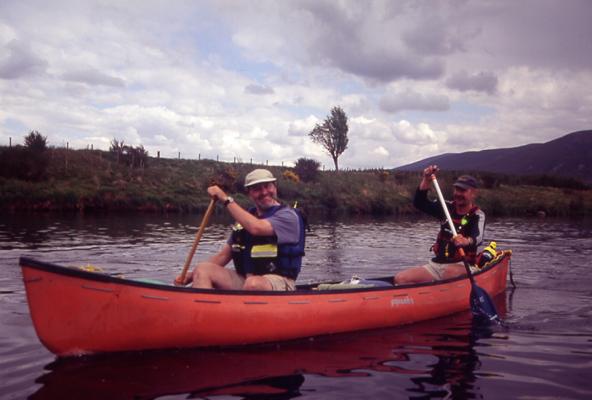
What is a canoe?
In general, it is boat with an open top which can be paddled by one or more people using
paddles with one blade.
It should not be confused with a kayak.
Shape, beam, freeboard and length:
Not all canoes are the same shape. The shape, beam, freeboard and length affect stability,
turning ability, and speed. Beginners will benefit from more stability. Longer canoes take
more turning, have a higher hull speed and will carry more people or equipment than short
ones.
Solo, doubles and multiple paddlers:
Canoes are versatile in that they offer a variety of paddling combinations and positions.
A solo paddler usually sits somewhere near the centre of the canoe and is free to paddle
on either side of the canoe. In contrast, doubles (and multiple) paddlers will each have a
side on which they paddle, usually only swapping sides in unison.
Paddles:
A canoe paddle has one blade. The length of the paddle should be suitable for the person
using it. Some paddles are easier to use than others.
Paddle skills:
The paddle skills required depend on the number of paddlers and positions in the canoe. A
solo paddler will use different strokes and techniques to doubles paddlers who, in turn,
use different strokes depending on whether they are in the bow or stern.
Enjoyment:
Keeping dry and warm for as long as possible will increase the likelihood of you enjoying
canoeing.
Safety:
Always wear a correctly sized buoyancy aid. If there is any risk of head injury (e.g.
excited children waving paddles about), wear a suitable helmet.
How to get started:
If you are under 18 years old you should look for a provider certified by AALA (the
Adventure Activities Licensing Authority). Jinaka Canoe Guides has an AALA Licence - details.
If you are over 18 (not covered by AALA), you should look for a provider with British Canoe Union (or equivalent) qualifications
relevant to the type of environment in which you will be canoeing.
To make an enquiry or to book, please send us a message
and we will reply to you.
Home Page